Cal AI Review 2026: Accurate Enough for Weight Loss?
Written by Robert Winter · Published June 26, 2026 · Last reviewed August 23, 2026
Cal AI is fast for photo calories, but accuracy depends on portions. Use this review to decide if Cal AI is enough or if you actually want to eat healthier.
Quick Answer
Cal AI is worth trying if you only want fast photo calorie estimates.
It is not enough if your real goal is eating better — cutting free sugars, limiting ultra-processed foods, and building habits around whole foods. A food photo can help you log a meal. It cannot tell you whether what you just ate is actually good for you.
Use this rule:
| If this is your bottleneck | Better choice |
|---|---|
| You hate typing foods into a tracker | Cal AI |
| You want scientifically precise nutrition math | MacroFactor |
| You need photo food and you want to eat healthier | Pureo |
The accuracy question matters, but the bigger question is whether you should focus more on food quality and healthy eating than the calories you eat.
What Is Cal AI?
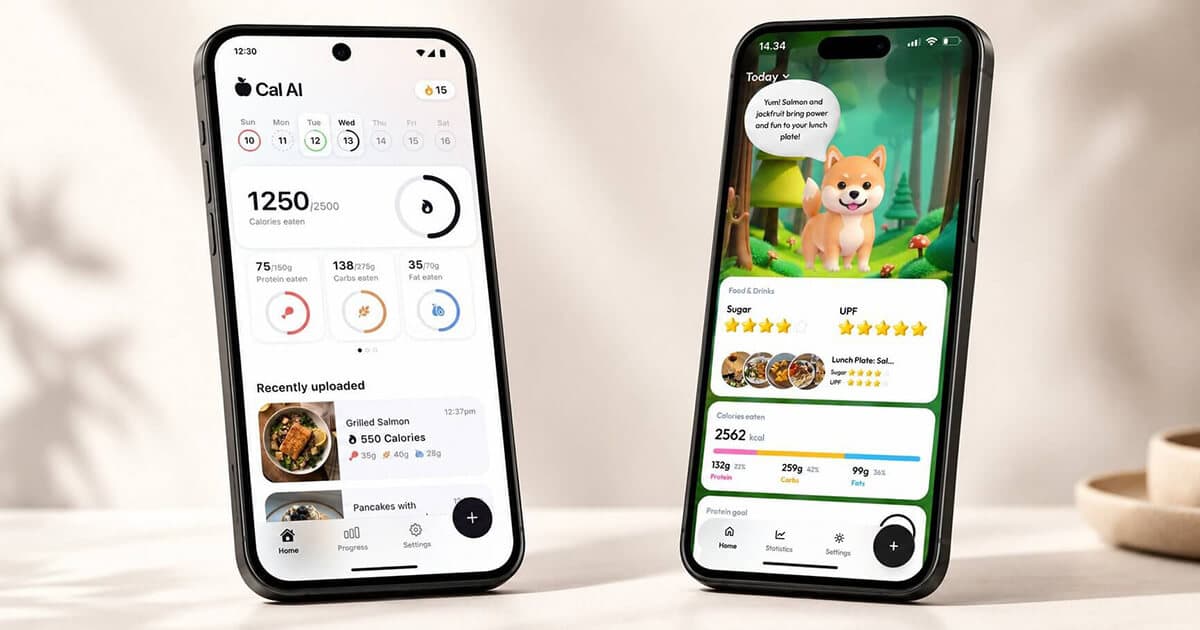
Cal AI is a mobile app that lets you photograph your food and get an instant calorie estimate using artificial intelligence. Point your camera at a meal, snap a photo, and the app returns a breakdown of calories, protein, carbs, and fat — no barcode scanning, no manual searching, no database scrolling.
It's a simple premise with genuine appeal: tracking calories is tedious, and anything that removes friction from the process has a real shot at helping people stay consistent. Cal AI raised its profile through aggressive TikTok marketing, and it's now one of the better-known names in AI-powered calorie tracking.
But does it actually work? Is the accuracy good enough to matter? And is it the best option in this category? Here's an honest look.
How Cal AI Works
Under the hood, Cal AI pairs computer vision with a large language model to recognize the food in your photo and gauge how much of it is on the plate. It then matches what it sees against its training data and produces a macro breakdown.
Here's the catch, and it's a significant one: calories are driven by how much you eat, not only what you eat. Spotting that a plate holds chicken and rice is comparatively easy. Judging whether you're looking at 150g or 300g of chicken from a flat, two-dimensional image is the genuinely hard part.
To cope with this, Cal AI leans on a mix of visual guesswork and details you supply yourself — you can note the container size or describe the dish. The upshot is an app that beats traditional tracking on speed while trading away some precision.
Accuracy: What Published Research Says
We did not run a private weigh-and-photograph lab study of Cal AI. Photo calorie apps share a well-documented limit: a camera cannot reliably see oil, dressing, or food density.
A 2023 systematic review in Annals of Medicine compared fully automated AI estimates from food images with human assessors and ground truth. Average relative errors for calories ranged from about 0.1% to 38.3% across studies, and error was typically smaller for single, simple foods than for mixed plates (Shonkoff et al., 2023).
An earlier meta-analysis of image-based dietary assessment found that these methods, like traditional food records, still carry meaningful measurement error when checked against stronger references (Ho et al., 2020).
That is why a ±20–30% swing on a complex meal is a reasonable planning range, not a Cal AI-specific score. For a 600-calorie lunch, a 20–30% miss is 120–180 calories. Over a day, stacked misses can reach a few hundred calories — enough to blur a planned deficit or surplus.
Where photo estimators tend to do better:
- Simple meals with distinct, visible components (a chicken breast with broccoli and rice)
- Standard restaurant portions of common dishes
- Snacks and single-ingredient foods
Where they tend to struggle:
- Casseroles, stews, curries, and any dish where ingredients blend together
- Foods with large calorie swings by portion (nut butters, cheese, oils)
- Mixed salads where dressing and toppings dominate the energy count
- Home cooking where portions deviate from an “average” plate
This is a category limit, not a unique knock on Cal AI. The practical question is whether the convenience trade-off is worth it for your goal.
Energy on a label is also not the same as energy your body uses. Cooking, fibre, and food structure change how much you absorb. That is another reason a tracker can only estimate intake — and why food quality still matters alongside the number.
What Cal AI Gets Right
Speed and friction reduction. The app is genuinely fast. Snapping a photo takes five seconds. For people who previously tracked nothing because traditional methods felt overwhelming, Cal AI is a meaningful step forward.
Decent for macro awareness. If your goal is general calorie awareness rather than precise deficit management, Cal AI is useful. Knowing you're eating roughly 500 calories versus 800 calories matters even if the exact number is off.
Good UX. The interface is clean and the experience is well-designed. The onboarding sets reasonable expectations and the results screen is readable.
Regular improvements. Cal AI has been actively developed, and later versions are often described as more usable than the earliest releases. That is a product observation, not an independent accuracy certificate.
What Cal AI Gets Wrong (or Missing)
It treats every calorie as equal. To Cal AI, a 200-calorie candy bar and a 200-calorie bowl of lentils are interchangeable. The app optimizes for hitting a number, not for the quality of the food behind that number. You can stay perfectly "on target" while eating almost entirely ultra-processed food.
No help reducing free sugars or ultra-processed foods. The WHO advises limiting free sugars. A tightly controlled NIH feeding study found that an ultra-processed diet led people to eat more calories and gain weight compared with a matched unprocessed diet (Hall et al., 2019). Cal AI logs what you ate; it does not coach those quality changes.
No adaptive targets. Cal AI gives you a calorie goal and does not adjust it from your weigh-in trend. Apps such as MacroFactor estimate expenditure from weight change. Pureo is built around logging plus food-quality scores, not a claim that it medically measures your metabolism.
Accuracy limits stack. If you eat three meals a day and each photo is off by a large percentage, the daily total can drift by hundreds of calories. For a precise deficit, that matters.
Cal AI vs Pureo
Cal AI is best judged as a food logger. Pureo is built to help you actually eat healthier.
Photo calorie tracking, calorie tracking from text, macro breakdown — Pureo covers the same daily logging jobs. The difference is that Pureo also scores added sugar and ultra-processed food so you can see food quality, not only energy. That is a product design choice, not a medical treatment.
| Feature | Cal AI | Pureo |
|---|---|---|
| Photo calorie tracking | ✅ Yes | ✅ Yes |
| Calorie tracking from text | ✅ Yes | ✅ Yes |
| Macro tracking | ✅ Yes | ✅ Yes |
| Quitting sugar | ❌ No | ✅ Yes |
| Quitting ultra-processed foods | ❌ No | ✅ Yes |
| Fiber targets | ❌ No | ✅ Yes |
Cal AI is calorie tracking and nothing else. Pureo is calorie tracking plus a plan to improve diet quality — at a similar price.
For someone who just wants to log food and watch a number, Cal AI is functional. If your goal is to change what you eat, a logger that only counts energy leaves the quality work to you.
Counting calories without looking at food quality is how people stay “on target” while eating mostly packaged snacks. Pureo connects the number to those quality scores so you can see both.
Who Should Use Cal AI?
Cal AI makes sense if:
- You want the fastest possible food logging with minimal friction
- You're focused on calories only, not quality
- You're new to tracking and want something approachable to start
It's not the right fit if:
- You want help reducing free sugars and ultra-processed foods
- You want guidance on food quality, not just a calorie number
- You want your tracking to actually change your eating habits over time
The Bottom Line
Cal AI does what it promises. The photo-based calorie tracking is fast, the interface is clean, and the app is quicker than typing every food. Its accuracy belongs to its category: useful for awareness, too coarse for exact bookkeeping, as image-diet research shows.
The bigger issue isn't a secret Cal AI error rate — it's scope. Cal AI counts calories but does not ask whether those calories come from whole foods. If your goal is to eat healthier, not only hit a number, a photo logger is a starting point, not a complete plan.
Pureo combines photo and text logging with sugar and ultra-processed-food scores. That is a more complete daily tool for diet quality. It is still not medical advice.
Download Pureo free on the App Store if you want to track meals and see food quality, not only energy.
Pureo
Download #1 Calorie tracking app
Pureo helps you to track your calories, quit sugar & ultra processed food, and reach your goals.


Primary sources
Health facts on this page are tied to these public-health and peer-reviewed sources. Product notes about Pureo are our own.
- AI-based digital image dietary assessment methods compared to humans and ground truth: a systematic review — Annals of Medicine (2023)
- Validity of image-based dietary assessment methods: a systematic review and meta-analysis — Clinical Nutrition (2020)
- Guideline: sugars intake for adults and children — World Health Organization
- Healthy diet fact sheet — World Health Organization
- Ultra-processed diets cause excess calorie intake and weight gain — Cell Metabolism (2019)
- Ultra-processed foods, diet quality, and health using the NOVA classification system — Food and Agriculture Organization of the United Nations
How Pureo tests this
This is a hands-on product review plus published research on photo calorie estimates. We compared logging flows and features. We did not run a private weigh-and-photograph lab study of Cal AI, and we do not treat vendor marketing as an accuracy score.
Read our editorial standards